Showing posts with label game review. Show all posts

Tuesday, May 16, 2017

Islands in The Veil: Cyberpunk PbtA

SNOW CRASH TEST DUMMIES
They say as you get older, your taste in music ossifies. That it’s harder for something new and novel to break through and grab your attention, create joy for you. I wonder if that’s true for rpgs? In the last year I’ve read a bunch I thought would grab me. I thought they’d hit the sweet spot of excitement I got when I first read the Ghostbusters or James Bond 007 rpg. Most didn’t.

The Veil did.

The Veil’s an amazing rpg which embraces modern cyberpunk-esque themes and ideas. I don’t know how else to explain it. I ran two sessions of it online for The Gauntlet Hangouts. I dug it and it left me wanting more. More than a formal review, I have some thoughts on it and why it works for me.

SOURCE TAGS AND CODES
I’m struck by the differences in The Veil’s approach to cyberpunk and my own experiences with that in games. I first encountered Cyberpunk 2013 in ’88 while at a shop in Chicago. Within a couple of years, it’d become a major rpg and trail blazed a whole series of like games (GURPS Cyberpunk, Cyberspace, CyberHERO, and of course Shadowrun. Cyberpunk 2020 became a go-to game for our local group up through the late 1990’s, with my late friend Barry in particular running many campaigns of it. Working at the local game store, I also got to peek in on other gamers’ approach to these games.

One thing divided me from many of the players and GMs: I’d read a lot of cyberpunk fiction: Gibson, Walter Jon Williams, Pat Cadigan, K.W. Jeter, George Alec Effinger. I wasn’t an expert or even that deeply into it, but I’d read these authors. That wasn’t true for many in our group. Some picked up bits and pieces. But for the most part, their vision of cyberpunk came from the RPGs rather than any novel or short story source material.

On the other hand they knew some sources I didn’t. Looking back it’s pretty clear that three anime heavily shaped their imagination: Ghost in the Shell, Akira, and most importantly Appleseed. I wouldn’t see those until much later; GitS not until this year. I hadn’t read the associated manga either. Appleseed leaned heavily into the chrome and military side of things. That complemented the typical games we encountered: we always played Edgerunners carrying merc missions of questionable ethics. We’d shift that formula from time to time, for example we got vampires in our cyberpunk once Ianus released their Grimm’s Cybertales and related products.

The Veil comes from another place. It’s the product of someone who has absorbed and synthesized the divergent streams of cyberpunk media: books, films, rpgs, etc. In doing so he’s made a game that has the anime feels and themes without being a caricature. The Veil’s cyberpunk without being entirely about murder, chrome, and loadout. It also manages to handle transhumanist themes while remaining comprehensible and connected to humanity. That’s something Transhuman Space, Eclipse Phase, and Mindjammer don’t do for me. It doesn’t feel like a regurgitation of older cyberpunk games, religiously sticking to the same play style and only redressing the setting.

PRODUCTIVE PLACEMENT
My disclaimer: I know Fraser Simons from online gaming; I’ve gotten to play with him several times. We even played The Sprawl together. That’s how I originally heard about The Veil. Honestly I only backed it because he seemed like a smart and earnest dude. I was prepared to be pleasantly bland about the game, probably praising its awesome look. But after getting The Veil to the table for two sessions I want more. It’s clicks for me. Years of gunbunny, amoral, and nihilistic cyberpunk had turned me off. The Veil flips that for me. It aligns with what I want out of a game.
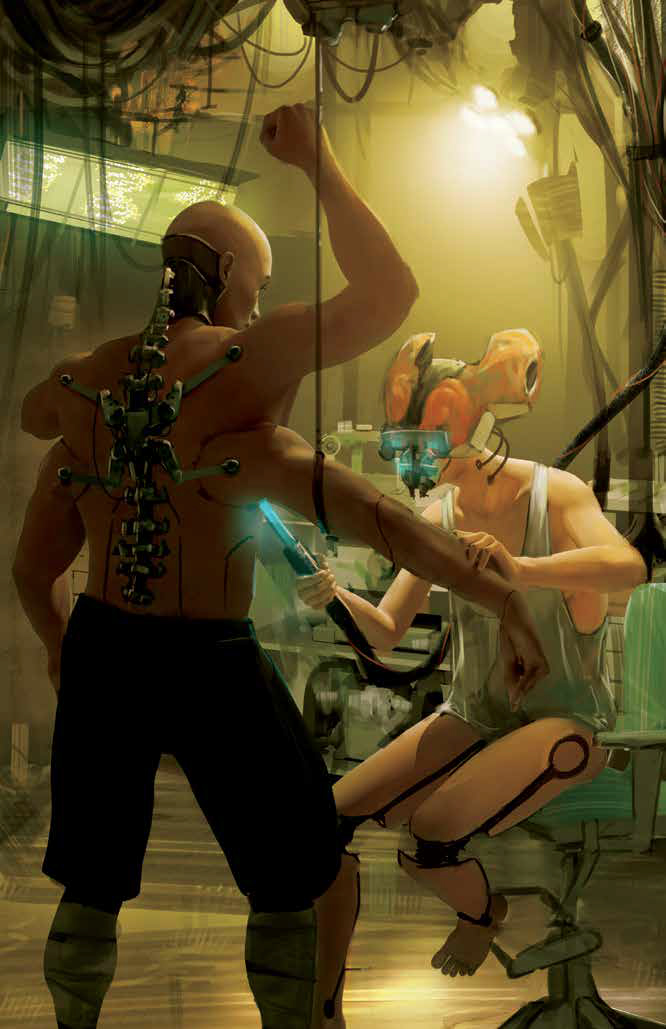
SPECIFICATIONS
The Veil’s a PbtA cyberpunk game, so it has system approach drawn from Apocalypse World and like games. It has a looser setting than other rpgs in the genre. Here player/MC collaboration creates the world. We’ve seen that before with The Sprawl, but it has a strong story structure. The Sprawl deliberately echoes classic burning chrome and grimy operator cyberpunk games, with a mission approach focusing play. The Veil has one key setting conceit, the Veil itself. The setting, however you create it, has a level of augmented reality everyone’s plugged into. Several actions in the game tie to the Veil literally and metaphorically. At first I wasn’t sure about that, but in play the device has brought cool moments to the table. Only after playing a couple of sessions did I realize how much you could shape the concept of the Veil itself: how it works, what it does, how potent it is, who has control.

Like most PbtA games, players have a set of basic moves. These tie in some of the cool concepts of the setting (the Veil as an info source, honor debts implied by giri). Fraser’s structured these moves smartly. More than other PbtA adaptations he keeps autonomy and choice in the players’ hands. There’s less of the “pick things that eliminate bad stuff hitting you” choices within the moves. The same smart approach carries over to the playbooks.

PLAYBACK PAYBOOKS
The Veil has twelve of playbooks. They’re all striking and distinct, carving out their own niche in the fiction. Each has a small, but evocative set of unique moves. These support the playbook’s theme but offer enough difference that picking a particular one at the start makes a statement about how you see the character. But as important as the moves, each playbook contains background questions and decisions. These aren’t just the usual relationship and backstory questions. They ask you to define fundamental aspects of the world and your role in it.

For example, The Veil includes the concept of Giri, an honor debt. It takes the place of debts, strings, bonds, from other PbtA games. The choice of terminology plays into some anime tropes. Characters who act as “Street Samurai” don’t have to be just killers, they tie into a moral code. Giri’s a global system with some supplemental moves. It serves as a mechanic for all characters.

But you also have the Honorbound playbook. This character builds on and changes the concept of giri within the setting. They enforce giri. The Honorbound player decides their “workplace” for & its relation to giri. They can define it as traditional, commercial, ritualistic, legalist, hidden. They also select circumstances which generate giri, a hugely important point. Whether you incur an obligation when you offend someone’s honor or breaking commercial contracts speaks volumes about your world. The kinds of penalties available to an Honorbound say something as well.

Sherri and I spent a long car ride talking about what the different formulations could mean. What if giri’s recorded and public? If it is transferrable and even sold on a market? You could also read/build a HB character just as a cop or a sheriff. Maybe it’s about wergild and keeping the peace through a balance of enforcers. What if the Honorbound acts behinds the scenes? There’s no officially accepted system for giri, but the HB’s order believes in one. They might be terrorists trying to shape society. If persons can incur giri, can an institution? an artificial intelligence?

Each playbook has something that it buys into and changes within the world. The Catabolist deals with cybernetics and inplants. The Apparatus about artificial life. The Architect about the metaverse & Veil. The Wayward about what lies about of the urban world. What the players choose as playbooks has dramatic impact on the game you’re going to play. That’s compounded by the background choices players make to flesh those elements out. That’s true in the best PbtA games, and the The Veil embraces that more than most. The combination and interactions of the playbooks within a group creates a distinct play universe.

MECHANATION
I haven’t talked much about the actual mechanics of play. If you’re familiar with PbtA, everything within The Veil should be easy to pick up. You may not get the implications of everything at first glance, though. It really builds emergent play. For example, characters don’t have “stats” like other games. Instead, they have states which represent emotions: Mad, Sad, Scared, Peaceful, Joyful, Powerful. So while rolls represent proficiency in the abstract, they’re more about characterization. The Veil has a “Feeling Wheel,” something I thought was dumb at first glance. It breaks down those emotional states into subtypes. It comes from therapy for emotional express.

My experience with tracking emotions in Headspace has made me doubly shy. But once we got the system to the table, I saw the beauty of it. Choosing your feelings helps explicate your character to yourself, the MC, and the other players. The wheel offers a non-intrusive vocabulary for that. As important, it almost always puts the choice and power in your hand when you go to make a roll. You don’t have to remember that X move uses Y stat. That’s gone. Instead you decide how this affects you. That’s smartly combined with an emotional spiking mechanic that makes spamming a particular stat dangerous. I dig it very much.

THINKING ABOUT CYBER
Sherri used to use the term “machine-love” for games, movies, and anime, that love The Tech. Gun lists, mecha suits, sweet bikes, hot chick robots—any media with a fascination with chrome and weapons. There’s a lot of old school cyberpunk where that’s your first impression. Characters are archetypes; they’re not fully fleshed beings. They’re iconic rather than evolving. The characters might have a unique spin or background, but they remain objects: dead, metal tools just as much as the equipment they carry.

The Veil doesn’t feel that way to me. It isn’t just that it uses the tag approach to cyberwear and guns. Its more about how it connects the characters’ lives to their place in the world. That makes it an open game. The Veil takes to heart the “play to see what happens” PbtA admonition. Each PC ends up with a ton of interesting material to play from. You can wrestled with the questions of place and identity we’ve seen in media like Ex Machina, Witch Hunter Robin, Accelerando, and beyond.

IN THE SHORT RUN
But that may itself be something of a weakness- or at least make it more challenging to bring The Veil to the table and get everything out of it. Character creation’s a deep part of the process. Players have many decisions, not just picks. They’ll begin to weave a tapestry in that first session. I knew that’d be a challenge in about five hours, split in two. I thought establishing setting details ahead of time would cut that cognitive load. That helped but we still put a long time into the CC process. We engaged with some of those elements in play, but we had many more directions we could have gone in.

Because of that we came away from those two sessions wanting more. Honestly as soon as I can figure out how to schedule it in, I’m going to run a longer term campaign of The Veil, either online or f2f. I think you’d need at least six, probably more like 10-12 sessions to get at the depth offered here. That makes scheduling challenging. The structure of the game and that richness also means I’m uncertain about offering this to my 6 player face-to-face group. I think The Veil benefits from a tighter PC party.

To be fair, I made a conscious choice to play from the book and engage the cc rules. Fraser has a quick-start, called Glitch City. That has a crafted setting and pre-gen characters. As well, the supplement he’s currently Kickstarting, The Veil: Cascade, has more material on how to scale this. I’ve backed that.

SMALL GLITCH
Any things that bother me? Yes, The Veil follows Masks in not actually putting the playbooks in the book itself. That really bugs me. We have sections discussing the elements of those playbooks, but not the questions and set up elements of those characters. We do get one page with images of the two pages of the playbooks, but they’re so small as to be unreadable. It frustrated me in Masks and I hope to god this isn’t the trend going forward for PbtA games.

END LINE
I need to wrap up and I haven’t even gotten to the form factor of The Veil. It’s gorgeous, with clean layout and great artwork. The pdf uses a white text background (yeah!). The softcover’s a-effing-mazing. It’s solid, larger than trade size. The glossy paper—something I often don’t dig—works here. I cannot believe this is Fraser’s first release. It’s one of the nicest rpg products I’ve bought.

Overall, Sherri and I love The Veil. It’s jumped to the top of my “must play more” list. As I mentioned above, at the time of this writing there’s a Kickstarter going on for the supplement. You can buy that alone or with the core book there. You can also just buy the core book via that campaign or from Indie Press Revolution. Highly recommended.


Gauntlet Hangouts Actual Plays
SESSION ONE
SESSION TWO

Thursday, March 9, 2017

Mutant Year Zero: RPGs I Love

I cut my teeth on Gamma World in the late 70’s, being blown up by Torc Grenades and eaten by psychic vegetation. But post-apocalyptic wasn’t really my thing. It would be another 30+ years before I played it again. My friend Dave ran a homebrew Fallout rpg, based on a video game I never dug. Had a great time, but filled my wasteland quota. But in 2014 I started my History of Post-Apocalyptic RPGs, one of the most requested genres. That finally put Mutant: Year Zero on my radar.

It wasn’t because the game immediately appealed to me. Instead I was trying to trace the evolution of the Mutant RPG, a Swedish release from 1984. Mutant had gone through multiple iterations- becoming cyberpunk in one and spinning off Mutant Chronicles in another. A couple of smart folks in my G+ feed recommended Mutant Year Zero. So I picked it up. And I read it. And then I ordered the GM screen. And then the dice sets. And then the expansions.

And then I ran it.

GLOOM AND HOPE
In Mutant Year Zero you play- as you might imagine- mutants in a post-apocalyptic wasteland. How that came to be isn’t clear. But it’s dark. You live in a desperate community overseen by an Elder, called an Ark. The world outside’s full of horror and The Rot. Your community’s primitive, just hanging on the brink. In the early days of a MYZ campaign, you check at the end of session to see how many people died. Even the mutations are messy and dangerous. They can explode and more problems. These challenges t ought to feel dark and hopeless.

But it doesn’t.

Partly that comes from how you build characters, partly from each session’s opening activity. I have a group of players who came out of a Fate-inspired campaign (control, competency). I worried how they’d react to this switch, but they’ve embraced it.

Sherri’s said that Mutant Year Zero stands at that perfect point between Trad and Indie gaming for her. It merges the atmosphere of both. You’ll first see that in character creation. You choose one of eight roles (Gearhead, Slave, Enforcer, etc). These are presented “playbook style.” So In addition to mechanical decisions you make picks from sets of choices: about your appearance, your relationships to other PCs, your relationships to NPCs, your Big Dream. These build bonds and develop details about the world itself.

The mechanical side of the game’s pretty simple. You assign numbers to the four stats and the twelve skills. These are low numbers, five’s max . Each role gets a unique 13th skill. These include the pathfinding of the Stalker, the deal making of the Fixer, the beast mastery of the Dog Handler, and the gang control of the Boss. You get one talent, feat-like abilities, and one random mutation. You also write down your gear. Then you build your Ark.
Sidebar: Gear: Here’s where Mutant Year Zero gets me. Encumbrance’s a traditional mechanic, a means of invoking ‘realism’ in the setting. In MYZ it becomes another point of pressure and hard choice. Normally I ignore encumbrance and item tracking because the complexity to payoff ratio’s pretty high. But this system’s so simple it works. You have a number of slots-- represented by rows on your character sheet-- equal to twice your Strength. So anywhere from 2 to 10. Most items take up one row. Heavy items take two rows and you can write in two light items on one row. OK, enough space for equipment and good. But you also need supplies to survive- grub, water, and booze. Four rations of these count as a single regular item. What do you do when you find a cool object in the waste? What do you drop?
BUILDING THE ARK
After character creation you take the hopeful connections to other characters and use those to build your Ark. As you read out your links and name NPCs, you collaboratively map out the community. You make a series of choices about what it looks like, how it feels, who has power. This starts you out with a collective sense of command and authority. You build a cool place you can invest in.

Then you find out what dire straits it is in. You have four development tracks- all important and vital: Food Supply, Technology, Society & Culture, and Warfare & Defense. Each has an impact on the fiction and the mechanics. For example, you need high Tech to understand artifacts easily. You need Food to reduce the number of deaths each session. All of these tracks start at zero.

But you can change this. There’s an “Assembly” at the start of each session where you choose a “Project”. These start simply: Basic Palisades, Pigsty, Temple. Later as they meet certain requirements, they get more interesting: Tavern, Water Wheel, Ink & Paper. It’s a Civ-like tech tree. Once a project’s selected, you can spend some your time and energy time working on it. You roll an associated Skill and count successes towards the number required to finish it. Early projects usually take a session to complete, later ones may take more. Of course you can only do one project per session. So every choice matters. For example, working on a project can be a hard call- other obligations and the siren call of exploring the Zone can eat up time.

In my group, the projects moved to the center. Players love them. They dig the choices and how they reshape the terrain of the community. It also ties into another important setting element: artifacts. I love the goofiness of the artifacts in this game. When an air mattress can be a significant find, celebrated by the players, you know it works. MYZ has a card deck which includes Mutations, Artifacts, and Threats. They’re a great and tangible handouts and players love them. It makes randomization easy.

How do these connect to Ark development? You’re supposed to turn over any artifacts to the Elder. They place them in “The Dawn Vault.” In game terms, artifacts turned in can raise your Ark’s ratings. A chainsaw gives +d6 Tech, a painting gives +d6 Culture, a crossbow gives +1 Tech and +1 Warfare. There’s social pressure to do this, which makes the choice interesting, especially when something’s useful. My players have leaned towards sacrificing things in order to make the Ark better.

DO YOU WANT TO ROLL AGAIN?
I need to dive into the Mutant Year Zero’s mechanics for a moment because they’re so supportive of the atmosphere. The game reserves test for important places; it specifically says to work to avoid perception-type rolls all the time. When you do make a test, you roll a pool of d6’s based on Stat + Skill. If you have appropriate gear you may roll its bonus dice. MYZ sells a set of dice for the game, you don’t have to use them, but they’re nice. Stat dice are called Base Dice (they’re yellow), skills use Skill Dice (they’re green), and equipment uses Gear Dice (they’re black).

When you roll, you want at least one “6”. That’s represented by the Rad Symbol on the MYZ dice. Each six is a success. You usually only need one success to win. But if you roll more successes, you get bonuses. In combat, for example, extra successes can be turned into:
  • Extra point of damage (repeatable)
  • Subdue or tiring- cause one point of Fatigue
  • Increase your Initiative by 2 for next turn
  • Knocking something from opponent (a weapon or object)
  • Knock them over
If you take a defensive action, for each success you can:
  • Reduce one success rolled by attacker
  • Subdue or tire- cause one point of Fatigue
  • Increase your Init by 2 for next turn
  • Knock something from opponent (a weapon or object)
  • Knock over
  • Counter and inflict straight weapon damage
Many of the unique role skills give bonuses to spend extra successes on. For example the Gearhead can make things stronger, have more uses, or be more reliable.

So again, all you need is one success…but more is better.

And you always have the option to push your roll. If you do, you pick up all the dice that don’t show a “1” or “6”. You reroll those. Add in any successes from “6’s”. Woot! Look how great and easy that was.

But…if you rolled any “1’s” on your Base dice (those from stats) you take damage on that stat. See your stats are also your damage tracks. So you get worse as you take damage. And keep in mind your stat’s going to be 5 at most. So that’s pretty rough. As well, if you rolled “1’s” on your Gear dice, you reduce that items rating by one per.

This makes for a tough, push-your-luck choice. Let’s say you really need to make a roll. Desperately need to. But on your first attempt, you rolled two “1’s” on your Base dice. Now you know that if you push your roll, you’re definitely going to take 2 damage on that stat. And you’re rerolling one other Base die, so if it comes up a “1” as well, you’re going out. But you’re also rerolling a bunch of Skill and Gear dice, so odds are decent you’ll get a success. These other dice can’t do damage to you, but you might deplete your equipment. But you have to reroll them all; you can’t cherry pick.

You can see the pressure. In play it’s awesome. We don’t roll that much, but when we do, it’s significant.

Want another push your luck mechanic? Consider mutations. Each session, you get a Mutation Point (MP), used to activate powers. As well, when you take damage from pushing rolls, you gain an MP per damage. So there’s some reward built into the system. Now when you actually activate a mutant power it happens. There’s no resistance or skill check. You spend a point and do X. I like that. BUT you do roll a die for each MP you spent. If you roll a “1,” then there’s a chance of a misfire. You roll another d6 to see what happens. That can be good: overclocking your powers or refunding your MP spent. Woot! But it cancan be bad, in which case you gain a new mutation power. But you also permanently lose a stat point.

Tough Choices.
Sidebar: Incidentally, Paul Beakley's written a ton of smart stuff about Mutant Year Zero. If you're interested, I recommend checking out what he says. He sees a lot of details I miss.  
DOWN DOWN DOWN THE FORBIDDEN ZONE
So what pushes you to the choices? What do you actually do in the game? Generally you’ll spend some time within the community, usually choosing between working on a project or carrying out your character’s agenda. You’ll also be responding to the Threat on the table, which may mean staying at home or venturing out into the zone.

At the start of a session, the GM randomly determines the Threat. I’ve been using the card deck for this, setting aside those I’ve already drawn. The core book has a random table. After the Assembly, the GM sets the stage and presents that threat. Some are local—sabotage within the community; some are nearby—some kind of monster stalking those who venture just outside the ark’s borders; some require a journey—locating a new filter for the community’s water purifier. They’re all robust and easy to riff on. A few might require more work (a murder among the community for example). Regardless Mutant Year Zero suggests not prepping for these. You should run with the randomness. It offers some other ways to do this, but the message overall is: put it out there and see what happens. Players will find their fun.

On the one hand you may really dig the Ark stuff. The game supports that with nice random tables for NPCs. There’s always going to be tension among Bosses within a camp, so you have cool power play stories. MYZ encourages social interactions in a couple of ways. First, several roles have skills that function mostly within the Ark. For example the Fixer can take time to set up deals in order to generate money (in the form of bullets) and/or resources. Second, there’s an easy mechanic for social manipulation, whether that’s via charm or intimidation. That doesn’t exclude role-playing scenes, but offers a nice backbone for it. Finally, the way MYZ doles out experience incentivizes social connections. It uses a series of questions (ala various PbtA games). Each “yes” answer generates a point of XP. Did you do work on a Project? Did you sacrifice or risk something for the NPC you want to protect? Did you sacrifice or risk something for the NPC you hate? Did you sacrifice or risk something for your PC “Buddy”? Did you make progress towards your Big Dream?

But you’re as likely venture out into the Zone, the land outside your Ark. And that’s a trad Hexcrawl. Mutant Year Zero supplies several maps broken into squares: desert, grey-tinged, pseudo New York, etc Take your pick. My players chose one with many lakes.. At the start of the game, you mark on the map. X marks the Ark. It’s hugely satisfying to take a permanent marker and writing on something like this. You can see the shape of the terrain, spot weird details printed on the map, and write in discoveries as you make them. This is some of the trad that Sherri mentioned.

MYZ has great tech supporting exploration. On the players side, they have to deal with questions of supplies and encumbrance. How armed are they? What artifacts are they carrying? How much grub and water do they take? That last one’s important because they have to spend one of each per day or suffer penalties. But they’re also the resource they spend to heal damage. Don’t take enough and they might be limping along for a long time. Eventually the PCs might buy talents to help offset this, but it remains a challenge. They also have to track the Rot, points of contamination which may build up in their system over time. On the positive side, several of the roles have cool skills related to exploration. The Stalker’s the most vital. Their skill Find the Path allows them to spot danger, move the group through quickly, or locate any cached artifacts. Players get XP for exploring zones as well.

On the other side, the GM has a set of great and easy to use random tables. That allows them to generate the kind of zone, the terrain, special features, and threats very quickly. It strikes a balance between too simple and too detailed. They can generate these on the fly or put together a list to work from. It supports the improvisation.

Plus Mutant Year Zero has write ups for several special zones with bigger stories. GMs can drop these in easily. Many offer new factions and peoples the PCs will have to deal with. Free League has also released several Zone Compendiums with new areas. Beyond that there’s also a meta-plot story connected to the origins of the PC’s ark and the fall of the world. Gamemasters can choose to use that or not.

Does it hold together? I’m not a usually a random charts GM. I’ll look through them for inspiration and sketch out lists for the game. They’re more toolbox than a tool. But Mutant Year Zero hits a sweet spot. It generates exactly enough bits to frame things. It plugs in the threats easily. It makes everything reinforce the atmosphere. I love it.

Last session the players worked their way through multiple zones. They’d managed to salvage a broken down truck a couple of sessions before. Now they set out for a strange location they’d gotten coordinates for. But they planned to do that via an Industrial Dump run by an NPC they’d met. We went through ghostly woods, they set fire to horrible zone crows who tried to keep them out of a building, they explored an abandoned church with strange graves outside, they opted to go around an unmoving yellowish fog, they sic’d a giant boar they’d mind control onto a group of cannibals holed up at an old gun range, they got caught in a torrential rainstorm as they traveled along the edge of a massive crater.

Finally at the dump site they got to dig through garbage, looking for artifacts and interesting scrap. That was a half-hour plus of rolling on the giant random item table: trombone, electric toothbrush, Santa mask, electronic keyboard, and more. They found only one artifact but it was awesome, a leather jacket in great shape with a flaming skull on the back.

It was the best.

FINAL BROADCAST
In short I’ve had a great time running Mutant Year Zero. I’ve not really run post-apocalyptic before, and MYZ makes it easy. It has the kind of lean mechanics I’m more comfortable with these day. It makes usually trad gameplay elements (like the Hexcrawl) work within that context. The system doesn’t take long to get, but it hides the sting. Life’s tough for your mutants. Your powers can kill you. Exploring can murder you. Just being outside can poison you. But for all that, seriously for all that, it feels hopeful. Players can build their Ark and leave a lasting legacy. I recommend it. 
Sidebar: Other Worlds: Mutant Year Zero has a sequel game: GenLab Alpha. It’s in the same setting, but you play Anthropomorphic Animals trapped in an automated experiment. The system’s entirely compatible and you can cross the two if you wish. But Genlab Alpha offers its own campaign, not about zone exploration. Instead you’re building an underground revolutionary network. You want to overthrow your masters and gain freedom from their murderous and arbitrary experiments. It’s cool and quite different. There’s a Kickstarter currently underway for the third game in the setting, Mutant: Mechatron- Rise of the Robots which has those as the PCs. Eventually we’ll see a final volume covering the remains of unmutated humanity. 
You’ll also see the MYZ mechanics in Coriolis, a sci-fi game. It changes up how the push system operates in an interesting way. I ran it twice. I talked about that on Episode 81 of the Gauntlet Podcast. I also posted the AP videos (session one, session two). The system also powers Tales from the Loop, which I can’t wait to actually try. 

Tuesday, February 14, 2017

7th Sea: Into Something Rich and Strange

TO THE BRIG
I’ve never been a pirate guy.

Not the Pirates of Penzance, nor Caribbean, nor Treasure Island, Nor Muppet Treasure Island, nor Yellowbeard, nor Sid Meier’s, nor even Dark Water.

So when I got offered a review 'ding & dent' hardcover of 7TH Sea, I went for it with a firm meh. I liked Wick’s work and I thought I could find some things to lift for my magical Renaissance setting. Plus it would be an interesting game for my TGI Thursday online series.

When I got the books, I read it cover to cover. I almost never do that with a core book. Instead I skim until I need to run it. I turned around and bought the 7th Sea pdf so I could easily make cheat sheets. When the Heroes & Villains supplement came out, I bought pdf immediately. I’ll keep buying them as they land. Now, today, I regret not backing this Kickstarter. I have a bunch of projects I’ve supported- fulfilled and unfulfilled- I’d have dropped in retrospect to support this one.

In short, I dig the new 7TH Sea.

I ran two sessions of it online. I’m basing my impression that plus my read-through of the core book and Heroes & Villains. You can see the actual play videos here (Session One, Session Two). Again, I received a review copy of this, so feel free to take this with a grain of salt. But I’ll tell you, I absolutely dig not expect to like this as much as I do.

LANDS OF THEAH
My knowledge of the original 7TH Sea setting extended to skimming splat books and looking to cannibalize the Freiburg boxed set. While I once had the core books, I never got far with them. That’s mostly because 7TH Sea echoed the mechanics of Legends of the Five Rings, a game loved for setting but not system. Also, as stated above: not a Pirate guy. I did like the idea of swashbuckling and musketeer RPGs like Lace &Steel, But 7TH Sea seemed super-Piratey. The CCG did nothing to disabuse me of the notion.

I’d followed the discussion when John Wick first got back 7TH Sea. The original setting had been problematic- laced with weird stereotypes, exoticism, and erasure. Wick promised to fix that. I can’t say if he has completely, but it feels pretty solid to me. The nations seem vibrant and, while they have historical analogues, possess their own character. That’s complemented by art that feels much more inclusive than most rpgs.* Good art, solid art, compelling art—all of which opens up the world and the stories to anyone.

Since I only planned to run the two sessions, I didn’t intend to delve deeply into the background. I wanted to know enough to get by. I’d slogged through the morass of too many rpg worlds. But that didn’t happen. I breezed through. The book opens with a little set up and then runs a quick cavalcade of the nations. There’s no massive timeline and footnoted research. Instead we get short but substantive discussions of each country. These offer perspective and don’t overstay their welcome. You can jump around or read through; the book doesn’t punish that choice. Instead it rewards you with intriguing puzzles. There’s much suggested but not fully explained, leaving enough imaginative space for the GM.

This set up smoothly transitions into character creation. That character begins by discussing what Heroes look like from each place. Then you have some easy choices to quickly assemble your PC. Backgrounds give starting elements, players spend to set their skills & traits, and then choose from a not overwhelming list of advantages. You’re over halfway through the book before you even realize it. That’s a combination of style, layout, and graphics.

THE RULES   To cover this, I’m lifting from my 7TH Sea cheat sheet
Dangerous or important actions are called Risks. When you make a risk, you roll a number of d10s = Trait + Skill.

In a Sequence, the GM sets the scene and you narrate your approach. Sequences can be Dramatic, Action, or Combat. That determines the Trait + Skill combination used to complete your action. It’s a tight list: five traits and sixteen skills. The GM may also establish Consequences and Opportunities for the sequence. All Risks have at least one consequence. Consequences can be things like breaking equipment, opposition arriving, taking wounds, etc. Opportunities are the “If you do well, you can X” bits. I’ll come back to that Opportunity idea later.

When you roll your dice, you assemble the results to make sets of ten. Each set is a Raise. Sometimes, you may use dice that add up to more than 10. That’s okay; it’s still a Raise. But if you don’t have enough points to make a 10, you can’t use those dice. Luckily there’s a mechanic for those extra dice.

You then use those Raises to complete actions. Consider them an action currency. Spend them to complete the task, avoid consequences, and get the benefits of opportunities. In combat, they’re a countdown clock as well.

Several small rules make this work well. First, players don’t have to spend their Raises only on their chosen Approach, they may Improvise. If a Hero wants to take an action outside the scope of the skill or trait rolled at the beginning of the sequence, they must spend an additional raise. Additionally if they don’t have the required skill, they pay an extra raise. High Skill levels (3-5) also offer extra dice tricks for those rolls, a small and easy to track mechanic.

The rules encourage creative approaches. Every time you use a skill you haven’t used before in a scene, you get a bonus die. Every time you give a quip or awesome description before taking an action, you get a bonus die. Not doing that means leaving money on the table. Characters can also apply “pressure.” They choose a particular action (“Attack Me,” “Run Away”) and spend a raise. If the target wants to do something besides that action, they must spend an additional raise.

HERO POINTS
You start with one Hero Point. You gain one when: you activate your Hubris (like a disadvantage or trouble aspect); you say “I fail”; you play in line with your Quirks (1 per session); the GM buys unused dice. This last one you’ll see most often. The trick is that when a GM buys those dice, they also get a Danger Point which they can use to power the opposition. Players can use hero points to add a bonus d10 before their own roll; add bonus 3d10 to another hero’s roll (limit one per round); active a special ability; act while Helpless.

ACTION SEQUENCES
If multiple characters take actions at the same time, the game goes to rounds. The GM sets the stage, again laying out any Consequences or Opportunities. Players declare their Approach for the round and roll raises. The player with the most raises describes their action and spends what they want. You may spend multiple raises on an action, but can’t later go back and add to it. Then play shifts to the player with the next most raises. This means that you may “act” multiple times in a round. Villains always go first when tied with players.

If the action isn’t about combat, but instead about something like crossing a burning room, you don’t have to go to order. You can instead check if players have enough to do what they want and determine how they spend their raises.

DRAMATIC SEQUENCES
These operate like Action Sequences, but turn order isn’t as important. Players roll to get raises to spend on the cool things you want to do: infiltrate a household, be awesome at a ball, pick up word on the streets, etc. The GM states the circumstances of the sequence in general and what you can expect. This includes the sequence’s scope, any dangers you’re aware of, and generally the sequence duration. These facts aren’t set in stone, and can change as the sequence progresses.

WOUNDS
Causing wounds is a Risk. In a combat, you spend 1 Raise to cause 1 Wound. You may spend additional raises to cause additional wounds. You can also spend raises out of action order to negate wounds 1 for 1. You can take wounds for allies by spending those raises out of order. The dueling mechanics are closely connected to this. There’s a set of standard maneuvers for duelists, with each style having one unique move. Duelist can spend their raises in combat to create additional effects.

Players mark wounds on a spiral track of twenty tics on their sheet. There’s a Star every fifth box. That’s call a Dramatic Wound. When you’re shot with a firearm, you always take a Dramatic Wound in addition to other effects. You can’t negate that with raises. Thankfully it takes 5 raises to reload a gun. A Hero with one or more Dramatic Wounds gains one bonus die on all risks. A Hero with two or more Dramatic Wounds grants two bonus dice to Villains rolling against them. A Hero with three or more Dramatic Wounds has exploding 10’s on all risks. In this case, if you roll a 10, you immediately add another d10 to your roll. A Hero with four Dramatic Wounds is Helpless. There are special rules when this happens. Standard wounds heal quickly, Dramatic wounds slowly.

Overall it’s a clean and basic system. Everything above is the backbone. They are some twists and sub-systems, like the dueling mechanics, but 7TH Sea is easy to pick up and explain.

THINGS WE DIDN'T GET TO
Running this as a two-shot meant we didn’t hit some of 7TH Sea’s interesting elements.
  • I’ve never seen an experience system quite like this. You write up a story for your character—a goal with a set of steps. You work through the story in play. The number of steps determines the kind of advancement it can be spent on once completed. The book offers several pages of ideas and templates to build these. It’s the most character-individualized development system I’ve seen.
  • There’s a set of structures for creating Villains. They have a Villainy rank split between Strength and Influence. Villains can invest Influence into Schemes, which can pay dividends. They can also use Influence to purchase secondary villains, Brute Squads, bribe officials, gain information, etc. Heroes can undermine a Villain’s stats indirectly or directly. The Heroes & Villains supplement offers rules which revise and replace some of these.
  • There’s a cool sorcery system. Several different styles exist and they’re completely different. I mean completely: conception, rules, effects. Each arises out of a particular national tradition and reflects that ethos. There’s destiny magic, portal control, gifts from nature, sinister bargains and more. We had a single sorcerer in our game, using Porte magic. Unfortunately we didn’t get a chance to see much of it executed.
  • There’s a rich section on Sailing. Players can gain a ship, which can have its own advantage-like Background. There’s good detail of sea bound life in addition to the mechanics. Like the rest of the rules, these don’t bogged down in detail.

RUNNING IT
I enjoyed running 7th Sea and I would run it again. I ran my own story, inspired by the first moment of the quickstart: an explosion. I went in another direction after that. I focused more on action than social scenes, something I’d like to correct next time I run. For PC pre-gens I picked twelve Heroes from the Heroes & Villains supplement. I tried to have a nice mix of nations, sorcerers, rogues, and duelists. To kick everything off I had the players define the villain they all hated, resulting in “The Viper.”

Part of my prep was reading Rob Donoghue’s sharp posts on the game. He helped me visualize some of the elements. I recommend checking those out if you’re interested. I don’t have a central thesis about the game beyond “It’s excellent.” But few details struck me as I ran it:

BADDIES
The adversary structure works for me. I like simple tracking for foes. I’ve also come to enjoy villain elements tied to an activation: PbtA’s hard moves, Coriolis’ darkness points, Chill’s tokens. Here Danger Points serve that purpose. I like that they come mostly from player choices. If the players want to sell their extra dice back for Hero Points, the GM gets equal Danger Points. These can also be used to add dice to a Villain’s pool and a few other options. I would like additional GM elements to spend these points on. RD has some suggestions and I’ll look at that before I run again.

I also appreciate the system for the lowest level foes: the mooks. Here they’re called Brute Squads. Each squad has a strength, representing the number of fighters involved. A Brute Squad isn’t treated as a character, but instead as a Risk. If you’re facing a Strength 6 Brute Squad, you need to deal six raises worth of effect to negate it. That would be wounds from combat, morale cracking from intimidation, or positioning from acrobatic trickery. If you only partially reduce a Brute Squad’s strength, they deal wounds equal to that remainder at the end of the round. It works well. Brute Squads can also have special abilities. I love the one where the squad can lose a strength point to carry off a vulnerable NPC.

SPECIFICS
I tend to be pretty loose with “skill calling.” I usually give players a couple of options depending on how they frame things. I’ll listen to good arguments about applying an offbeat skill to a situation. Most GMs do that, but I’m really loose. I don’t think that’s a great approach with 7th Sea. You only have sixteen skills, so they each have a broad reach. Not sticking close to the book definitions means that the improvisation and ‘no skill’ mechanics have less meaning. I’m going to tighten that up if I run again.

Ahead of the game, I worried most about the Duelist rules. I’d heard they trumped everything else in earlier 7th Sea. I’d also seen Rob Donoghue mention they required some special handling. I saw that a little in play. Bottom line: a duelist is significantly more dangerous in combat. They have many options and deal more damage. That means when you have a combat sequence, you need to have challenges for them (large squads, duelist villains, etc) as well for as the non-duelist characters. If you watch the AP you’ll notice that when dealing with Brute Squads only, I had the duelists abstract a bonus to the wounds they dealt, rather than going tic by tic. That’s not something in the rules, be aware of that. Brian mentioned to me that he’d heard dueling was a slowdown point for the rules, like Netrunning in Shadowrun. I don’t think that’s true. The GM just need to keep things moving.

SEQUENCE FRAMING
While I dug 7th Sea, it presented a challenge to my usual GMing approach. The book has excellent examples of play, well worth reading through. (On dueling in particular, you should check out the sample duel from the Heroes & Villains. Some sequences frame a differently than I’m used to. At the start of a non-combat sequence, the GM lays out the situation and costs if there’s a Risk involved. The players declare what they’re rolling (skill & trait) and then spend raises to avoid consequences and gain opportunities. That’s a moment that can potentially break the flow. Instead of players declaring actions, rolling and then narrating results, the order shifts a little. The GM sets the stage more explicitly.

With multiple people working in the action sequence, I had to pause and configure the situation. How many opportunities do I need we have multiple players in the scene? How do I give the players a chance to narrate their results? Does it seem interesting to go through each person’s result? Dramatic Sequences present a different problem. They generally occur over a wider range of time. I haven’t quite got a sense of the scale—especially if different players in parallel end up working in different spans. How many rolls are we expecting? Just one for the whole sequence? The example in the book seems to suggest that. But if one player uses up their raises in an interaction and another’s slowly working through their’s what happens? I’m not sure about that.

I suspect with play, I’ll figure this out. At the table I stumbled over it in session one where I had two parallel groups operating. One triggered combat, so I pushed the other forward to involve them. For action sequences, I probably need to think about them in a more trad way. Picture it as the players needing to get at least an X result, and having the potential to do better if they roll well. Overall I need to run more and/or watch others run it. I may be making this more difficult than I need to.

OPPORTUNITIES
One of my big stumbling blocks was opportunities in sequences. On the one hand, the GM’s expected to put some forward. The rules say they’re optional, but you’ll want to have them there to add color. Raises are a currency in the game. If you have a currency in play, the GM needs to give the players something to spend that on. On the other hand players can generate these opportunities themselves. Several of the PCs’ talents relate to that. The book calls these “narrative permission slips,” but doesn’t explain much beyond that. That left me (and the players) uncertain about the scope.

Here’s where that’s a problem. I mentioned above my tendency to be loose with skills. I’m the same way with scenes and elements. “Is there a chandelier?” Yes. “Can I see something heavy to put against the door?” Yes. “When I push the captain of the guard to safety, can I slam the door behind him so no one can reach him?” Yes. In some of these, I could have said, “Yes, if you spend a raise for that opportunity.” That gives the players something to buy, encourages thinking, puts pressure, and works with the rules as written. That would also have modelled the kinds of opportunities players could have explicitly asked for.

If I ran again, I think I’d spend some prep time brainstorming opportunities. It might be worth just doing a big list of interesting details for sequences. It’s a reverse of thinking about costs & consequences or soft moves. I need envision memorable and useful opportunities. That’s assuming I’m thinking about opportunities correctly. I’m not entirely sure I am. I’d like more guidance on that and I’m hoping later books will consider that.

OUT TO SEA
At the end of session two, we did a round of Roses & Thorns, giving our impression of the game. Rich said an interesting thing, that my experience with Fate gave me a leg up in running this. I don’t think he’s wrong—there’s a parallel openess in the approach. But 7th Sea is just different enough that I can just fall back on my old tricks and style. It requires some thinking. I’m looking forward to doing that more because I can see a definite payoff.

If you’re interesting in the genre at all, I recommend buying this. Consider getting a hard copy, because it’s a lovely book.

Reminder: I received a review copy. But then I went and bought the pdf and the pdf of the supplement.


Tuesday, December 13, 2016

Cryptomancer: What's Your Paladin's Password?

INTRODUCTION
Never underestimate the power of a good cover. That’s how Cryptomancer grabbed my attention. It looks strong and iconic, not messy and confusing. And then I saw the game’s simple, clear pitch line: fantasy hacking. Hacking what? I wanted to discover. In G+ discussions no one knew. Their curiosity hadn’t pushed them to pick it up. A first-time publisher and complex seeming character sheet worked against it. But I took the dive, and I’m glad I did.

Cryptomancer’s a fantasy game about information security. It isn’t what I expected- it’s better than that. Rather than just abstracting hacking as a series of rolls, it makes the players work for their success. That could have been complicated, but it manage to simplify while providing a rich world that spins out of the magical advances it puts into play.

My review’s based on reading and having run two session for The Gauntlet’s TGIT Hangouts. We recorded the sessions and you can see those here.

THE SET UP
Cryptomancer is an rpg about “hacking in a Tolkienesque high-fantasy setting”. In this world, magical developments have massively impacted how people live and how the powerful maintain control. It’s a setting rife with conflict and intrigue. It has some pretty important setting premises and details. You can’t approach it like any other fantasy game. Instead you have to know more about how the world works to make informated choices.

The Peoples (Adapted from the Cryptomancer site descriptions)
Dwarves “Warrior Architects”: Merchants, mechanics, and master cryptomancers responsible for the proliferation of the Shardscape. Dwarven clans leverage the Shardscape to coordinate guerilla warfare against waves of orcs threatening their underground strongholds, as well as participate in the intrigues of the surface world, playing human versus elf to their own advantage.

Humans “The Experiment”: Young race of mortals struggling to reconcile their feudal imagination with the Shardscape, a realm where birthright and conventional power mean nothing. While humans of limited means leverage the Shardscape to establish and organize labor guilds, crime syndicates, and other resistance communities, those in power leverage it to surveil the restless masses and control them though propaganda

Elves: “Sylvan Parasites”: Industrialists who decimate great forests to harvest soma, a highly-coveted and profitable commodity. Elven tribes leverage the Shardscape to manage their soma supply chains and control massive swaths of forest otherwise impossible to hold with their limited numbers.

All three peoples are highly factionalized internally.

Who Are The PCs?
To set this up, you first have to understand about The Risk Eaters. They’re a secret cabal of powerful mages who consider themselves the protectors of the realm. They want stability above all else. To do this they consult calculation engines to read fates. If something or someone has or will upset the balance, they deal with them via assassinations, market manipulations, puppet regimes, or levelling city-states.

The PCs have been marked as a future threat. Why? Unknown. The Risk Eaters now hunt their steps, forcing them underground. They operate as a cell of agents on the run, acting against this oppressive regime.

Connections
Two magical developments have connected this world: Cryptomancy and the Shards.

Cryptomancy: Basically, anyone can encrypt a communication into a cipher with a keyphrase. That encrypted communication appears as “clear text” for anyone who has heard, read, or spoken that phrase in their lifetime. When this happens, the subject become aware of the keyphrase so they can pass it on. Everyone wants unique keyphrases to prevent others from decoding them.

Alternately a person can encrypt using a True Name and Soul Key. Everyone has both, but the only the bearer can share their True Name. Soul Keys cannot be passed. When someone hears a communication encrypted with their True Name, it decrypts. The reverse holds true: something encrypted with a Soul Key can only be decrypted by someone who know the associated True Name. True Names are highly valuable then, but the more people who know it, the greater risk of it being mishandled.

A Cryptomancer cannot magically encrypt an already encrypted communication. However, they can encrypt a conventional code. So an agent might encode a phrase that has a particular meaning for the recipient.

Shards: Magical crystals into which users can project or receive communications. When they do so, they can send to or read from any other Shard cut from the same stone. These sets are called shardnets. This happens instantly and over any distance. Communications leave “echoes” which last a number of hours equal to the number of shards on the network. Bearers can use Cryptomancy with a shardnet, via thought rather than speaking. A shard must be held in hand to be used. This is an obvious and visible action.

Other Interesting World Details
  • Secure shardnets usually have cryptoadmins who check and oversee communications. They may have several shardnets they coordinate. They may also bridge shardnets by holding two different shards. Sometimes they’ll have a keyphrase for particular networks.
  • Massive constructed golems can be used to connect and administer shardnets.
  • Cryptoadmins usually have a secret registry containing lists of valid users, schedules, and passphrases. Good cryptoadmins track any and all messages left in their shardnets.
  • Couriers carry posts between locations, posting them on communal Message Boards. Encrypted messages can then be read by those in the know.
  • True Name cryptosigniatures are often used to secure legal documents.
  • There’s a massively accessible shardnet, simply called the Shardscape. It has so many fragments, echoes remain there insanely long. Searching through the echoes takes time.

THE SYSTEM
Cryptomancer uses a unique resolution system. It isn’t quite like anything I’ve ever played. It took some getting used to. At heart it’s a skill-based system, with skill ratings derived from stats. You roll a pool of dice looking for successes, but…

Characters always roll 5 dice for any test. They roll d10’s equal to their skill rating. Any remaining dice use d6’s (called fate dice). Any dice which meet or beat the difficulty number count as a success. A 6 on a fate die always counts as a success. Everything has one of three difficulties are: Trivial 4+, Challenging 6+, and Tough 8+.

BUT then they must knock off successes for each “1” rolled on the d10’s or “1 or 2” on the fate d6 dice. These “botches” can hit hard. If characters get -2 or fewer successes, that’s a dramatic failure and horrible things happen. -1 success means they simply fail and 0 successes means a failure with a silver lining. If someone only gets 1 success, they do it but with complications. With 2 successes characters do it cleanly and with 3 or more awesome things happen.

Players have two ways to deal with Botches. Some talents allow a character to ignore one or more for particular checks. They can also choose to ignore all the botches on the fate dice (the d6’s). If they do so, they increase the group’s Risk. I’ll come back to that.

STATS
Characters have four core stats. These can have a value of 4, 6, or 8. Two attributes derived from each of those core stats. Those go from 1 to 5. You decide what you have by dividing the core stat number. So with a 6 Power, a player could split the values 1&5, 2&4, or 3&3 among the two attributes
  • Power: Strength & Endurance
  • Speed: Agility & Dexterity
  • Resolve: Presence & Willpower
  • Wits: Knowledge & Cunning

Six of the eight attributes have associated skills. Willpower and Endurance do not. They’re used for magic and health respectively. Skill is equal to the attribute it’s under. These don’t increase, but players can buy talents to make them better with these. Everyone can roll for any skill.

The core stat has another big purpose. It sets the target number when someone tries to affect a character in that area. It’s clever, clear, and means you generally don’t roll opposed checks.

COMBAT
When someone attacks, they roll against the difficulty of the target’s defense. On the character sheet, defenses are listed next to the core stats in the big circles (Take Cover, Dodge, Parry, Resist). A higher number is better.

Cryptomancer has a novel way of handling initiative. Whoever says “I attack” goes first in a combat. That side goes, then the other. But once they say, “I attack,” they’re committed, even if it turns out to be a bad idea (like the person who emerged from the shadows actually came to help).

Damage is # of success plus any bonus from the weapon. If a character takes 3 HP in a hit, they’re in bad shape and bleed 1 HP if they act and move in a turn (Critical). If they take 4 HP in a hit, they just bleed 1 HP per turn (Mortal). Consider that everyone has HP equal to their Endurance +5, so no less than 6 or more than 10. That means combat can be pretty lethal and fast.

The system has a number of other combat tweaks. For example, sneak attacks add Stealth successes to damage. There are Grapple rules. But overall it doesn’t feel overwhelming. It helps that it takes a simple approach to things like weapons and equipment.

These primarily have descriptors for color, but some also give a mechanical effect. But mostly they offer a nice hook for the fiction. Armor also has descriptors—the important ones are Light Deflection (ignore 1 HP wounds); Heavy Deflection (ignore 1 or 2 HP wounds); and Damage Reduction (reduce damage by 1).

TALENTS AND MAGIC
Talents cover conventional feats characters can use. The character sheet marks that out in an interesting way. A filled-in triangle beside a skill means the PC has an associated talent. It reminds the player to check that in their talent descriptions. Magic comes in three levels, measuring power and reach. Anyone can learn magic. Spells generally require a Willpower test. Spells cost MP.

THE LONG GAME
When you try out a game in with a one or two shot, you inevitably miss some portion of the rules or setting. Cryptomancer contains a ton of long-term ideas and resources, concepts we didn’t get to the table in our session. It’s built as a extended campaign with players making investments, developing resources, and digging themselves in deeper.

Downtime
Cryptomancer contains decent rules for handling “off screen” actions. Many of these focus on the creation side of things. Downtime’s roughly an eight-hour period, an important consideration when the group’s working against the clock. It has rules there for healing, learning, brewing potions, crafting items, developing social networks. Finally there’s “Following a Lead.” That’s represents research and recon, done with a single roll to gain a clue or piece of info.

That’s an interesting move. It doesn’t mechanize the “legwork phase” of the game as much as The Sprawl does. But that downtime choice feels like a mechanic to handle players who don’t want to play things out and instead want to go to the dice. Alternately, you could read it as a “hit the streets” action (something we’ve seen in some PbtA games, including Worlds in Peril). Essentially a move for when the players feel like they’re stuck or directionless. That’s how the book presents it. Since this only gains players simple information, it suggests actually playing out the scene allows for more information. I’d have to think about how I want to handle that. The book suggests a minimum number of successes to gain info. I’m not as keen on that. I prefer a more GUMSHOE approach: key information given for the work, plus additional info for successes or additional costs for failures.

Strategic assets
Cryptomancer has a conventional advancement system. You can learn spells or add talents. “Narrative gaps” between campaigns can be used to raise attribute ranks. But jobs and challenges also pay off with strategic assets. The group can spend this to improve their organization. These can go to three things.
  • Safe Houses: There’s a sheet for tracking the group’s safe house. By default it provides a secure location for the PCs. They can also improve that by adding new rooms and facilities: an alchemy lab, a cryptoadmin, a library, a training room and so on. They can also buy a “transfer” of the safehouse improvements if the team’s location or situation drastically shifts.
  • Cells: The network of contacts and operatives the group can call on. These include scouts, agitators, cleaners, unlikely allies, and beyond. Players have to choose if they keep particular cells at a distance, making them deniable, or close, making them tied to the group. The latter approach gives the cell more skill dice to roll.
  • Mounts: Useful transport for the group.
Risk
I mentioned the Risk Eaters above. Even if the players aren’t directly facing these foes, their influence and authority hangs over the world. Risk is measured as a percentage, the chance that the Risk Eaters will find and dispatch operatives to deal with the group at that moment. Risk comes from badly handled operations: casually inflict violence, create attention, use poor security measures, ignore tradecraft practices. Any of these add to the group’s risk score. As well, the cost for ignoring botches on your Fate dice I mentioned above? Increasing your risk.

Everything Else
I haven’t even gotten to the deeper world-building that takes the implications of the Shard and Cryptomantic technologies and runs with them. Or the large section on handling missions and how tradecraft worlds in a world like this. It’s a substantial core book.

WHAT I LIKE
  • Premise: The concept of fantasy hacking excited me, but I also made me wary. I’d seen “hacking” done badly, essentially just a minigame of rolls. I’d also seen forced and thin net analogues. Cryptomancer cuts around that. It assumes a secure system. You don’t run the net. Instead you have to find the real world vulnerabilities, the gaps in the system’s armor, and the points of entry. And most often those will be people.
  • InfoSec: The game’s about information security, but scaled down and presented in a way you can grasp. It makes Private Key/Public Key encryption ideas work with Elves. How crazy is that? It sets up cool ideas and blends with seamlessly with the setting. There’s a spell to “Encrypt” a doorway, creating a maze-barrier someone can’t pass through without the keyphrase. There’s so much more.
  • Writing: The book’s solidly written and compelling. It has a clean and effective layout. The art’s good and consistent throughout. I liked the little bits of fiction and appreciated the organization. It’s a big book as well. Add to that a free 48-page expansion the designer’s put out. He could have easily charged for that, but instead he released it for early adopters.
  • Mechanics: The system works. It’s fun and fast. Combat’s quick and deadly. It takes a page from Dungeon World and similar games: abstracting equipment with tags and offering slimmed down monster templates. As a GM you roll, a pool which can slow things a little. I rolled a table to results and burned through those for the NPCs. That sped things up.
  • Background: It has a good and rich material for the GM. The tools support a long campaign, with players learning how to operate and developing their own styles. The Risk Eater backdrop gives a great hook right out of the gate.
Basically I really dig this game, so the criticisms below are really minor. They’re more things to be aware of when you read the book.

THINGS TO WATCH FOR
  • Character Sheet: The character sheet’s smartly designed, but on first glance looks hella complicated. It’s solid once you get a grip on the game. Be aware that it may be a little off-putting initially.
  • Missed Rules: Because Cryptomancer isn’t like other systems I know, it took a bit to get a handle on. A few places bury rules. For example the mechanic for ignoring fate die botches isn’t in the resolution section. It’s tucked away in the part on Risk. Willpower’s used for most, if not all spellcasting checks. That’s mentioned in passing under Willpower in the skill list. But it isn’t discussed in the general section on spells. Instead each individual spell states you need to roll that. That worked against my speed prep for the game , I’d read the general magic rules, but had skipped all the specific spells. So when the question "what do you roll?" came up, I flopped through the book looking for a broad rule. So minor, but all of that’s to say that while it’s at heart a simple game, you’ll want to read through it a couple of times before you run.
  • Backstory: This is a heavy world, but players need to have command of a ton of operational details: races, factions, cryptomancy procedures, shard systems, etc. A GM’s going to need to convey that to the players. In my group, and many others I know of, the GM’s the one buying books and occasionally the players. I wish the rules had one or two quick reference handouts for the setting. I pulled my own together, but even that misses important info. I don’t know the best solution to this problem.
  • Death Spiral: The PC’s are doomed. They will generate risk and rise in threat level to the Risk Eaters. These foes will send more and more potent hunters. There’s no mechanism for reducing risk. The book makes a point of that and that the Risk Eaters are too big to be taken down. GMs will have to decide how they want to handle this frame and tone. Players should know the implications going into a campaign.
  • Dungeoning: A couple of times Cryptomancer says it hasn’t forgotten about the hack & slash side of things. it hopes to handle the dungeon delving side equally well. But it’s a dangerous game: characters have a small HP pool and that won’t change much throughout the campaign. It’s closer to something like GURPS Fantasy for scale and lethality. Its approach to monsters and the like is closer to Dungeon World. That’s not a bad thing, but something you should know going in. A classic D&D dungeon might slaughter the party.
  • Adventure: The book contains a sample adventure/campaign starter. If you plan on running it, take a long look at the pre-gens available at the back. The scenario presents the challenges without clear advice about solutions. That makes it more difficult for the GM to visualize and clarify things to the players. The PCs do have the resources to win- odd spells and talents to see them through. But until you really put the two things together it can feel very unclear.
  • Production: The pdf lacks layers. Given that every page has illustrative grey sidebars, that’s a problem for printing. The core book’s giant, clocking in at 400+ pages, a good thing. While I like the printed copy, the paper’s a little thin. There’s some bleed-through for reading. As well the pages have started to do that “curl” that you get from lots of ink and lightweight paper. I should note that my hardcover came with the cover torn away from the spine. I only mention that to say how well and quickly DriveThruRPG responded to email about this. They offered a replacement or, if the damaged book was in usable shape, sending out a printed copy of another book I wanted. Class act!
OVERALL
Cryptomancer’s a great game and one that came out of nowhere. I hadn’t seen much talk about it in my gaming feed. A search shows more discussion of it in connection with InfoSec than RPGs. For a first product, it’s amazingly well produced: smart, complete, and with strong choices about things like the art. It is a planning, investigation, and thinking rpg. That’s not everyone’s bag and it doesn't abstract that. But it’s also one that shows its real strength over time. I highly recommend it.

Cryptomancer on DriveThruRPG
Videos of our AP Sessions